


What the First Week of the 2026 FIFA World Cup Reveals About FIFA’s Expanded 48-Team Era
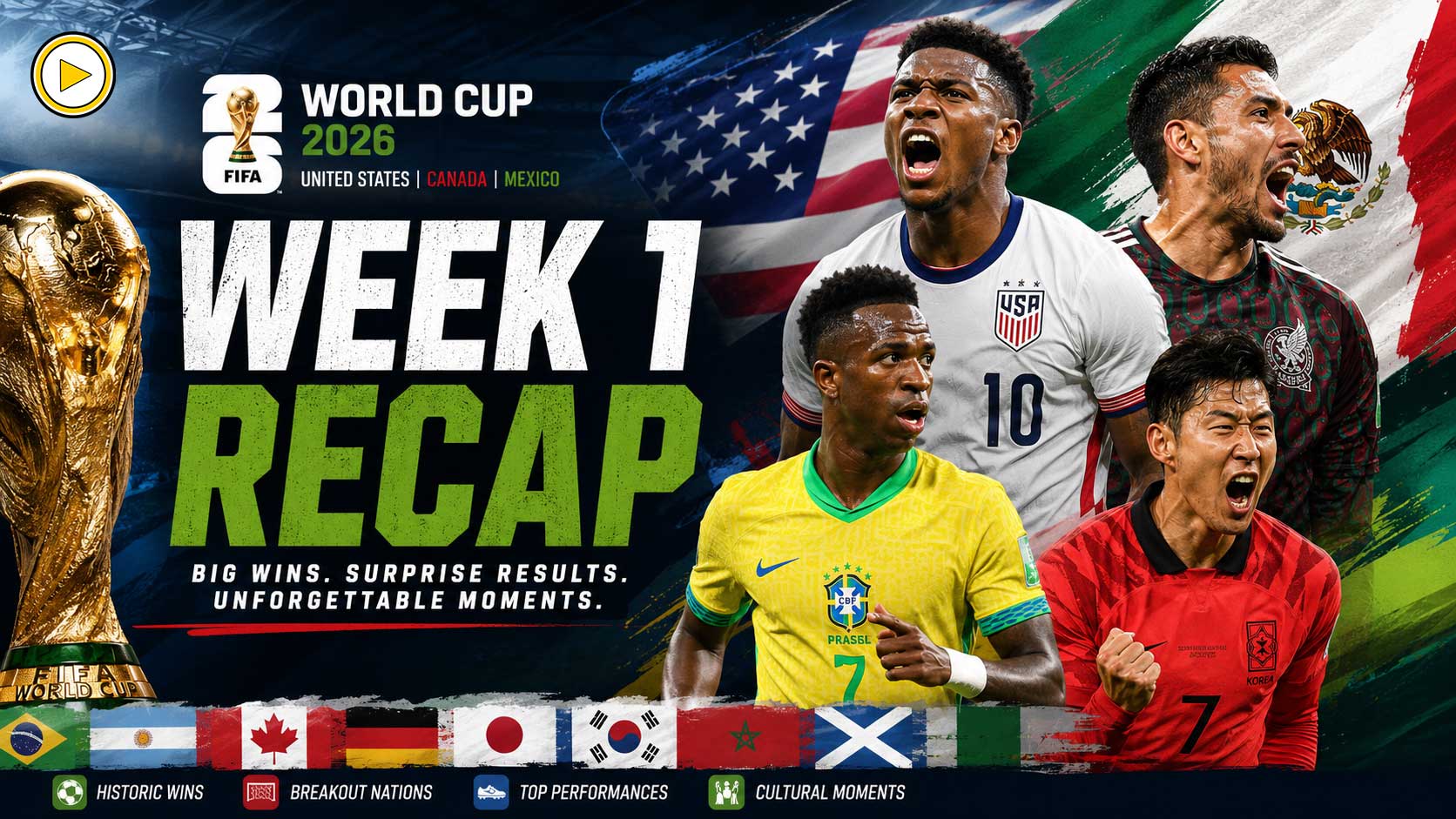
The 2026 FIFA World Cup is only a few days old, but the tournament has already delivered the kind of drama, emotion and unforgettable moments that remind the world why soccer remains the planet’s most powerful sport.
With matches spread across the United States, Mexico and Canada, the first week of action has showcased everything from dominant performances by traditional powers to historic milestones for emerging nations. For Latino fans, the opening stretch has also carried added significance, with Mexico, the United States, Brazil, Ecuador, Uruguay and several other regional powers beginning their journeys under the brightest spotlight in sports.
The tournament officially kicked off in Mexico City, where Mexico defeated South Africa 2-0 to open Group A and give El Tri supporters an early reason to celebrate. The victory immediately energized the host nation and reinforced expectations that Mexico could make a deep run on home soil.
The United States delivered one of the strongest opening statements of the tournament, defeating Paraguay 4-1 in Los Angeles. The performance instantly placed the Americans among the early teams generating momentum and excitement heading into the second round of group-stage matches. Meanwhile, Canada earned a 1-1 draw against Bosnia and Herzegovina, securing its first point and first World Cup goal on home soil.
While the host nations grabbed headlines, several surprise stories quickly emerged.
South Korea opened its campaign with a 2-1 victory over Czechia, positioning itself as an early contender in Group A. Scotland captured its first World Cup finals victory since 1990 with a 1-0 win over Haiti, sparking celebrations throughout Scotland and among supporters worldwide.
One of the most talked-about results came when Brazil was held to a 1-1 draw by Morocco. The result served as an early reminder that the expanded 48-team format may create more competitive group-stage battles than many expected. Traditional powers can no longer assume three points against emerging football nations.
Germany produced the tournament’s most dominant performance so far, dismantling Curaçao 7-1 in Group E. Yet the scoreline wasn’t the biggest story. Curaçao became the smallest nation ever to qualify for a FIFA World Cup and celebrated its first-ever World Cup goal, a historic moment that resonated throughout the Caribbean diaspora. Even after the heavy defeat, supporters viewed the match as a landmark achievement for the island nation.
Sweden also delivered an early statement with a commanding 5-1 victory over Tunisia, while the Netherlands and Japan played to one of the most entertaining matches of the opening week in a 2-2 draw.
Beyond the results, Week 1 has highlighted the evolving nature of international football.
The expanded 48-team tournament was designed to bring more nations into the global conversation, and early returns suggest FIFA may have achieved exactly that. Instead of a tournament dominated solely by Europe and South America, emerging programs such as Curaçao, Cape Verde, Morocco and South Korea have already generated compelling storylines and drawn significant international attention.
For Latin America, the opening week has been a mix of optimism and caution. Mexico delivered a strong start. The United States looked sharp. Brazil showed flashes but left questions unanswered. Ecuador, Uruguay, Colombia and Argentina are still preparing to enter the spotlight, meaning the region’s biggest stories may still be ahead.
Off the field, the World Cup’s cultural impact has been impossible to ignore. Opening ceremonies across North America featured performances from global music stars including Shakira and Burna Boy, reinforcing the tournament’s role as a global entertainment platform as much as a sporting competition.
From a Latino perspective, that’s perhaps the biggest takeaway from Week 1. This tournament isn’t just being played in North America—it is being shaped by North American culture. Spanish-language broadcasts, Latino fan bases, Latin music performances and the presence of major Latin American nations have created an atmosphere that feels uniquely representative of the region’s growing influence on the global stage.
As the second round of group-stage matches begins, the pressure will increase dramatically. Teams that opened with victories can position themselves for the knockout rounds, while early underperformers face the possibility of seeing their World Cup dreams end before the tournament truly begins.
If Week 1 proved anything, it’s that this World Cup is already delivering on its promise of unpredictability.
And if the opening days are any indication, the best moments are still to come.
For continued World Cup coverage, match analysis, Latin music culture and the stories connecting sports and entertainment, follow LaMezcla.com and stream curated playlists inside the LaMezcla Music App.