



What the Knicks’ NBA Title Means for Latino Representation in Professional Basketball
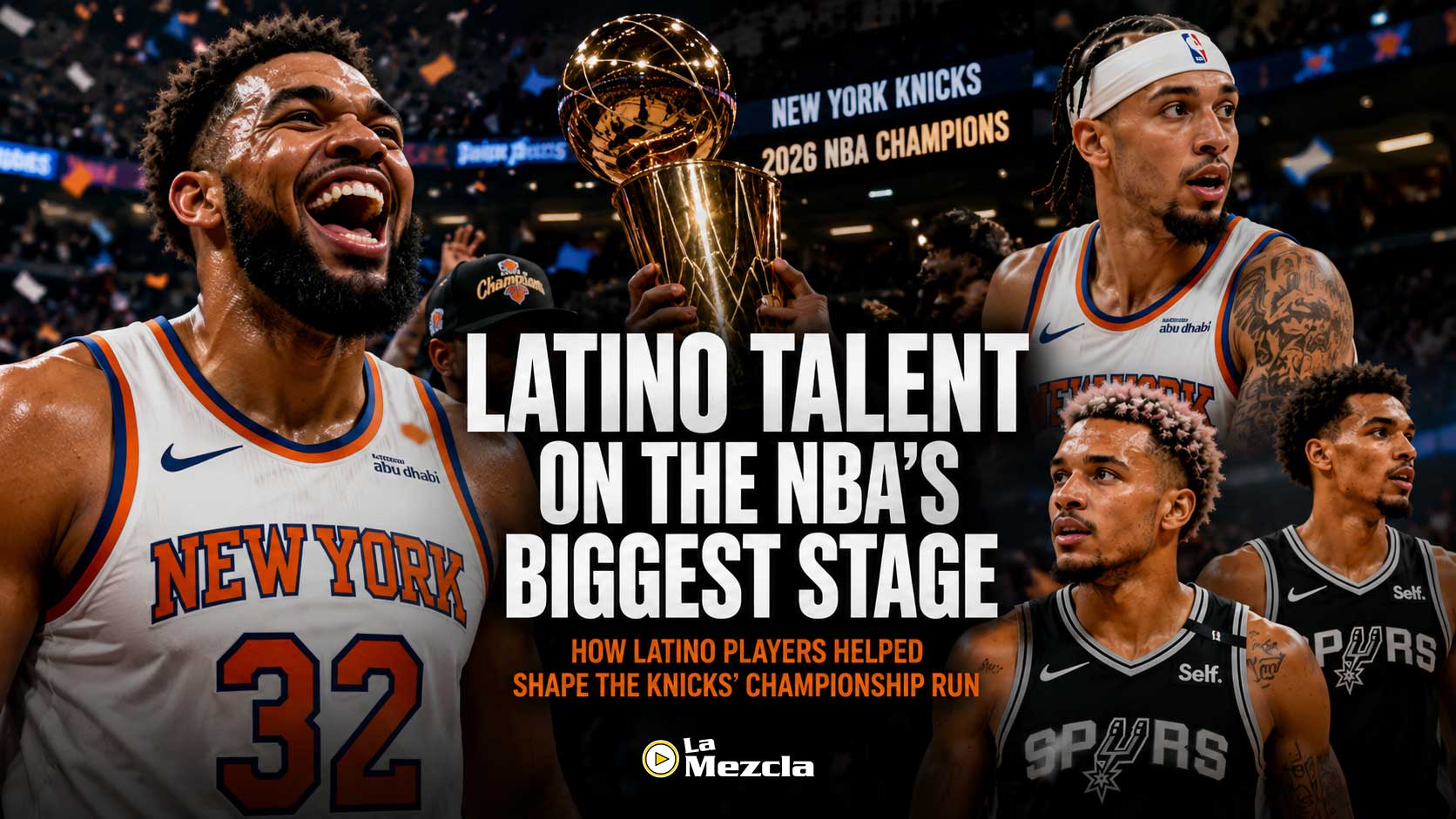
Knicks are NBA champions for the first time since 1973.
After decades of heartbreak, rebuilds, near misses, and countless jokes at the expense of one of basketball’s most passionate fan bases, the Knicks finally ended their 53-year title drought with a 94-90 victory over the San Antonio Spurs in Game 5 of the 2026 NBA Finals. Led by Finals MVP Jalen Brunson’s unforgettable 45-point performance, New York closed out the series in five games and delivered a championship moment generations of fans thought they might never see.
For Latino basketball fans, however, this Finals carried another layer of significance.
While much of the national conversation centered on Brunson, Victor Wembanyama, and the Knicks’ long-awaited return to glory, the series also showcased one of the strongest displays of Latino representation the NBA Finals has seen in recent years.
On the Knicks side, Dominican-American star Karl-Anthony Towns became a central figure throughout New York’s championship run. Born in New Jersey to a Dominican mother, Towns has long embraced his Dominican heritage and remains one of the most recognizable Latino athletes in American sports. His arrival in New York helped transform the Knicks into a legitimate title contender, giving the franchise the interior presence it had lacked for years. While his Game 5 performance was not his strongest, his impact throughout the season and playoffs was instrumental in helping the Knicks reach the mountaintop.
The Knicks also featured Puerto Rican guard Jose Alvarado, whose relentless energy and defensive intensity became valuable pieces of New York’s postseason rotation. Alvarado has emerged as one of the NBA’s most visible Puerto Rican players, carrying the same fearless style that has made him a fan favorite internationally and with Puerto Rico’s national team. His contributions during the Finals reinforced the growing presence of Puerto Rican talent on basketball’s biggest stage.
Adding another Latino connection was Jeremy Sochan. The versatile forward, who has openly embraced his Polish and Mexican heritage, became another example of how today’s NBA reflects increasingly diverse backgrounds. While his role evolved throughout the season, his presence in a championship-winning locker room further highlighted the multicultural makeup of modern basketball.
On the opposite side stood a young San Antonio Spurs team that may have lost the Finals but appears positioned to remain a contender for years to come. The Spurs featured several players with strong connections to Latino communities, including Mexican-American roots represented within the organization and a roster that reflects San Antonio’s deep cultural ties to Latin America and Mexico. The city itself has long served as one of the NBA’s most culturally Hispanic markets, making the Finals feel like more than just a championship series—it felt like a celebration of basketball’s growing diversity.
What makes this moment particularly notable is how different it feels from previous generations of Latino representation in basketball. For years, Latino players were often viewed as exceptions. Today, they are foundational pieces of championship contenders. Karl-Anthony Towns was not simply participating in the Finals; he was one of the reasons the Knicks were there in the first place. Jose Alvarado was not merely filling a roster spot; he was contributing meaningful playoff minutes. That evolution reflects a broader shift in the sport.
The timing is also significant because basketball’s popularity continues to expand across Latin America and among U.S. Latino audiences. While baseball and soccer have traditionally dominated those conversations, the NBA has quietly built a stronger connection with Latino fans through players who proudly represent their heritage both on and off the court. The 2026 Finals became another example of that growth.
For New York specifically, the championship carries unique cultural weight. Few cities in the world are more diverse, and few fan bases are more deeply connected to Latino communities than the Knicks. From Washington Heights to the Bronx, from Queens to Brooklyn, generations of Dominican, Puerto Rican, Mexican, Colombian, and other Latino families have supported the franchise through decades of disappointment. This title belongs to the entire city—and that includes the Latino communities that have helped define New York’s basketball culture for generations.
The Knicks’ championship will be remembered primarily for ending one of the longest title droughts in professional sports. But years from now, it may also be remembered as a moment when Latino representation stood prominently on basketball’s biggest stage.
For a league that continues to grow globally, that’s a story worth paying attention to.
And for Latino basketball fans everywhere, it is a reminder that the next generation is no longer watching from the sidelines—they are helping write the history.
For more stories exploring the intersection of sports, music, culture, and the Latino community, follow LaMezcla.com and discover the voices, moments, and movements shaping what’s next.